Claude Code and the British Newspaper Archive
A first pass
through the papers
A worked example from the Shetland Times and Shetland News: the Book of Black Arts, and the Cullivoe storyteller.
For Mark Smith, Shetland Museum and Archives · James Stewart · October 2026 · use ← → to move
What this is, and what it isn't
It does
- Run dozens of narrow searches in a few minutes
- Read the snippets and the OCR text, and throw out the false hits
- Come back with a citation for every claim, linked to the page
- Tell you what it searched for and didn't find
It doesn't
- Know anything the archive doesn't hold
- Replace reading the page yourself
- Read every OCR error correctly
- Prove something isn't there: a missed search can just mean bad OCR
Think of it as a research assistant who takes the first pass at the papers. You still decide what matters and check the sources.
The setup
You
Ask a research question in plain English
→
Claude Code
Plans the searches, following a short instructions file
→
Your Chrome
Already logged in to the BNA. Claude uses the site the way you would
→
Cited notes
Paper, date, page, a short quote, and the searches that found nothing
No special access and no bulk download. It reads the search results, the BNA's own OCR text for an article, and, when that's garbled, a crop of the page image.
One rule for this demo: the BNA is the only source. I have my own research files on this machine, and none of them fed into what follows.
The instructions it follows
A "skill" is a plain text file Claude reads before it starts. This is the whole of a BNA-only one.
Saved as .claude/skills/bna/SKILL.md, it's used whenever you ask a newspaper question.
My working version adds notes on the Shetland Times' publication days, the gaps in the digitised run, and how the OCR mangles names.
---
name: bna
description: Search the British Newspaper Archive
in my logged-in Chrome and report cited findings.
---
Use only the British Newspaper Archive. No other
websites, files, or prior knowledge.
1. Plan narrow searches: one or two keywords,
a title, a tight date range.
2. Read the snippets first. Discard false hits,
and say why.
3. For promising hits, read the article's OCR.
4. If the OCR is garbled on a name, date or
number, look at the page image.
5. Report the answer, the citation (paper, date,
page, article), a short quote, and every
search that found nothing.
Never enter passwords. Never bulk-download.
The question
What do the Shetland papers hold about the Book of Black Arts in North Yell, and about the Cullivoe storyteller on the 1980 Radio Shetland tape?
Taken from your "Black Book" story for the Spooky Stories night. Tom Tulloch was named in the post, so he became the second half of the question.
Step 1 · Search, then read the snippets
Most keyword hits are noise
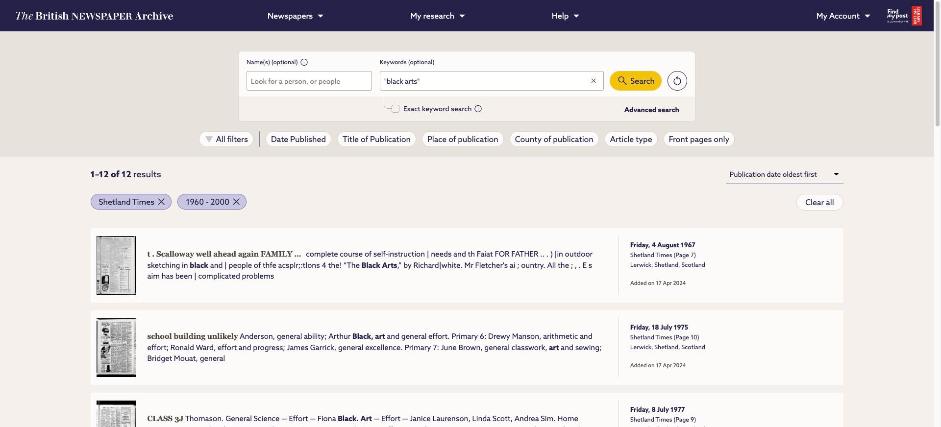
"black arts", Shetland Times, 1960–2000: 12 hits.
The OCR runs list entries together: "Arthur Black, art and general effort" on a 1975 school prize list matches the search.
Claude reads every snippet and throws these out before opening anything.
What it threw away, and what it didn't find
The misses are part of the result
| Search | What came back |
|---|
| "black book" yell | 1961: a look back at 1960's football, and the names in the referee's black book |
| "black art" yell | 1888: a review of J. Sands' rhymes about the witches who plotted against James VI. 1984: roads funding "something of a black art" |
| tocher tulloch | 2,008 hits: "tocher" is also the Scots word for a dowry |
"black book" cullivoe
"black art" cullivoe | Nothing |
| "book of black art(s)" | Across the whole BNA: Victorian fiction and English papers. One Orkney hit, from 1864 (slide 11), and nothing from Shetland |
The Book of Black Arts itself didn't turn up under any phrasing tried. That isn't proof it was never printed: OCR misses words, and the Shetland Times run in the BNA stops at 2000.
Step 2 · Narrow the dates
The storyteller is easier to find
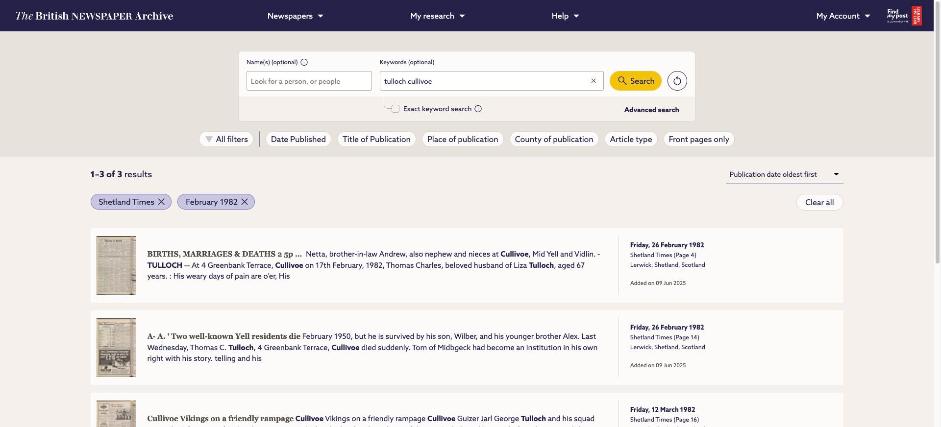
"tom tulloch" cullivoe turned up dialect letters signed from Greenbank Terrace, Cullivoe, and an in-memoriam notice giving a death date of 17 February 1982.
A second search on just the weeks after his death found the death notice and the obituary.
Step 3 · Read the article OCR
Tom Tulloch of Midbreck, 1914/15–1982
"an institution in his own right with his story-telling"
- Thomas C. Tulloch, 4 Greenbank Terrace, Cullivoe. Died suddenly on 17 Feb 1982, aged 67
- Born and raised at Midbreck, North Yell; later postmaster at Gutcher
- Learned the old tales from his mother and aunt. The School of Scottish Studies drew on him, and an issue of Tocher was largely about him
- Gave talks on Radio Shetland
- His son Lawrence of Gutcher carried on the storytelling
Shetland Times, Fri 26 Feb 1982: p4 (deaths) and p14 ("Two well-known Yell residents die"). Fri 17 Feb 1989, p4 (in memoriam). Fri 19 Jun 1998, p17 ("Yell sea tales"). Birth year worked out from "aged 67".
Step 4 · When the OCR fails, look at the page
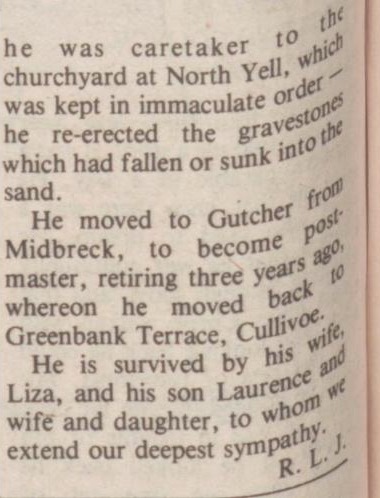
The end of the obituary ran into the binding
What the OCR gave:
He moved to Gutchef ;'J Midbreck, to becom€ "0 master, retiring three years "y whereon he moved b":., Greenbank Terrace, Cull¥"sfe He is survived by M J Liza, and his son Lauren® 'g
So Claude cropped that column straight from the page image and read it: "his wife, Liza, and his son Laurence".
The obituary spells him Laurence; the 1989 and 1998 items have Lawrence. It flags the difference instead of picking one.
Along the way
"Black art" in the island papers
| Paper | What it says |
|---|
Orcadian
4 Oct 1864, p3 | A farmer at Outertown, Stromness, has his horses maimed and crops wrecked. Rumour says his neighbours own "books of Black Art". The closest thing found to the Book |
Shetland News
31 Oct 1885, p6 | "Shetland Folk-Lore", from the Glasgow Herald: Scalloway people suspected of the "black art" within living memory |
Shetland News
19 Sep 1891, p7 | Luggy the warlock's pact with the devil on the shore, and the live fish he drew up on a line from his knowe in a storm |
Shetland Times
Jun 1897, p5 | A folklore series on Johnsmas witchcraft (snippets only, not read in full) |
Only the 1864, 1885 and 1891 articles were read in full. Leads, not conclusions.
What it took
~20
searches, across the Shetland Times, Shetland News, Orcadian and the whole BNA
~10
articles read through the BNA's own OCR text
1
crop of a page image, where the OCR failed on a name
~10 min
from the first search to the findings above
What it needed from me: a BNA subscription, logged in, and the question. What it still needs from me: checking each citation against the page before anything goes into print.
Where to be careful
OCR
Names split and letters swap ("Halerow", "Sin clair"). A search can miss what's on the page.
Coverage
Only what the BNA has digitised. The Shetland Times stops at 2000, and there are gaps (spring 1915, part of 1932).
Inference
It can join dots that don't join. Here, "born 1914/15" is worked out from "aged 67", and labelled as such.
Copyright
Short quotes and citations, not transcripts. The article stays in the archive; the notes point to it.
Trying it
Four things to set up
- Claude Code, Anthropic's command-line tool (needs a Claude subscription)
- Claude in Chrome, the browser extension that lets it drive a tab
- A BNA subscription, logged in, in that Chrome
- The skill file from slide 4, saved in your project folder
Then ask it a question, the way you'd brief a colleague. I'm happy to sit down and set it up with you, or run a search on something you're working on.